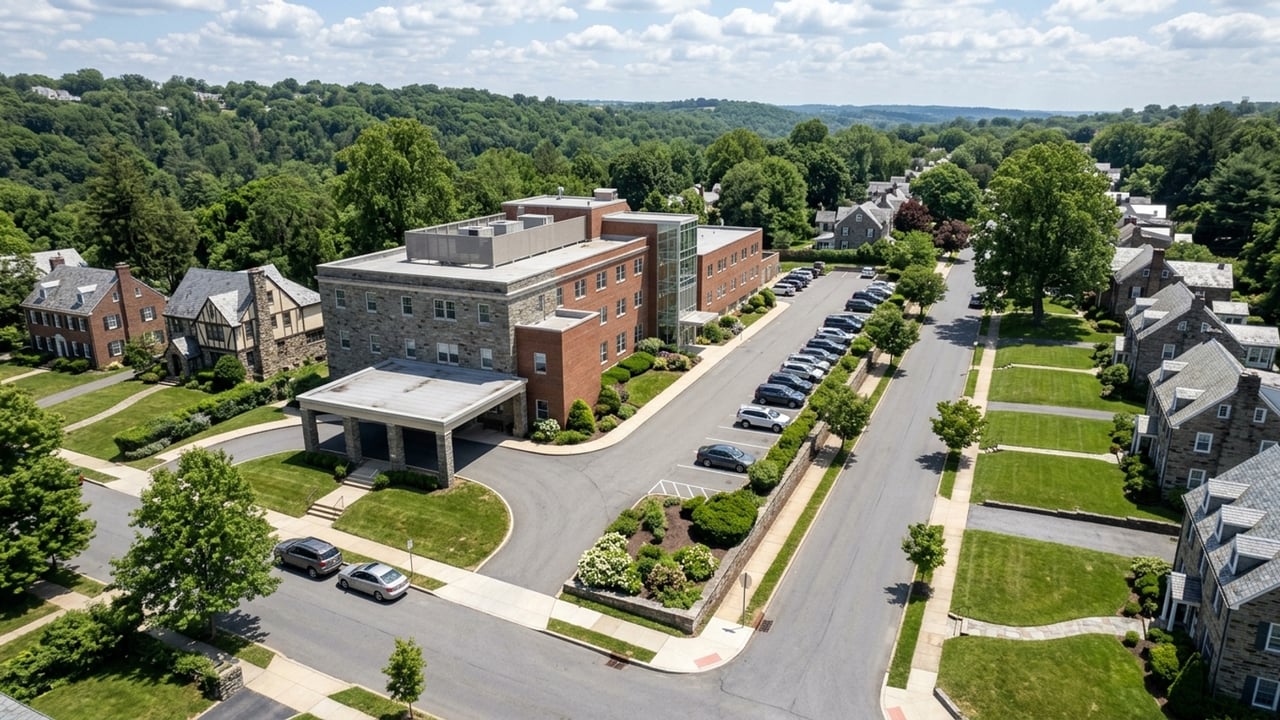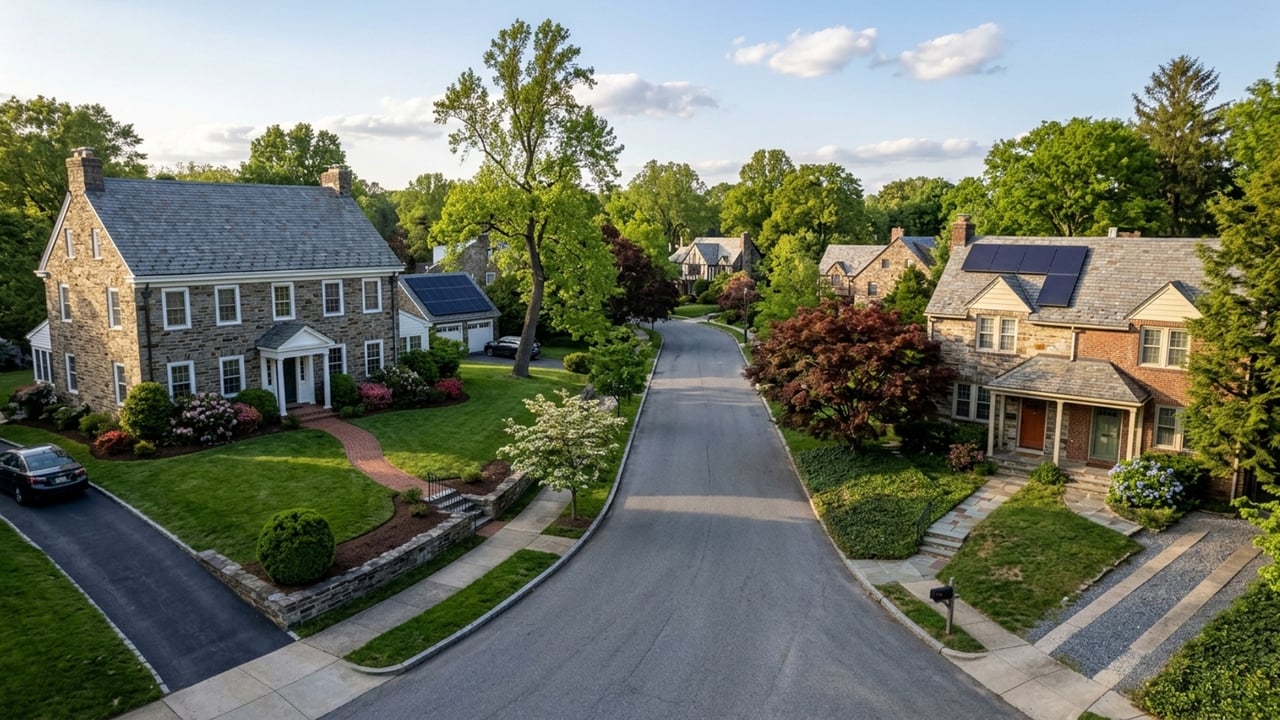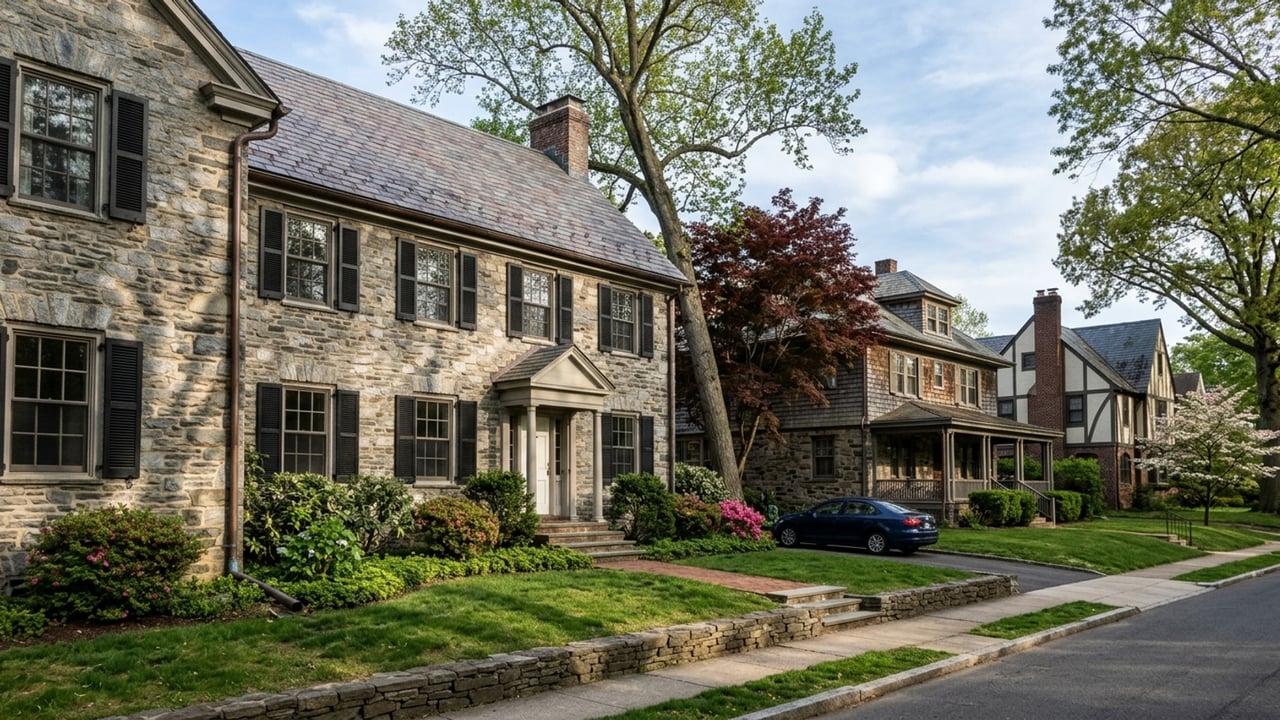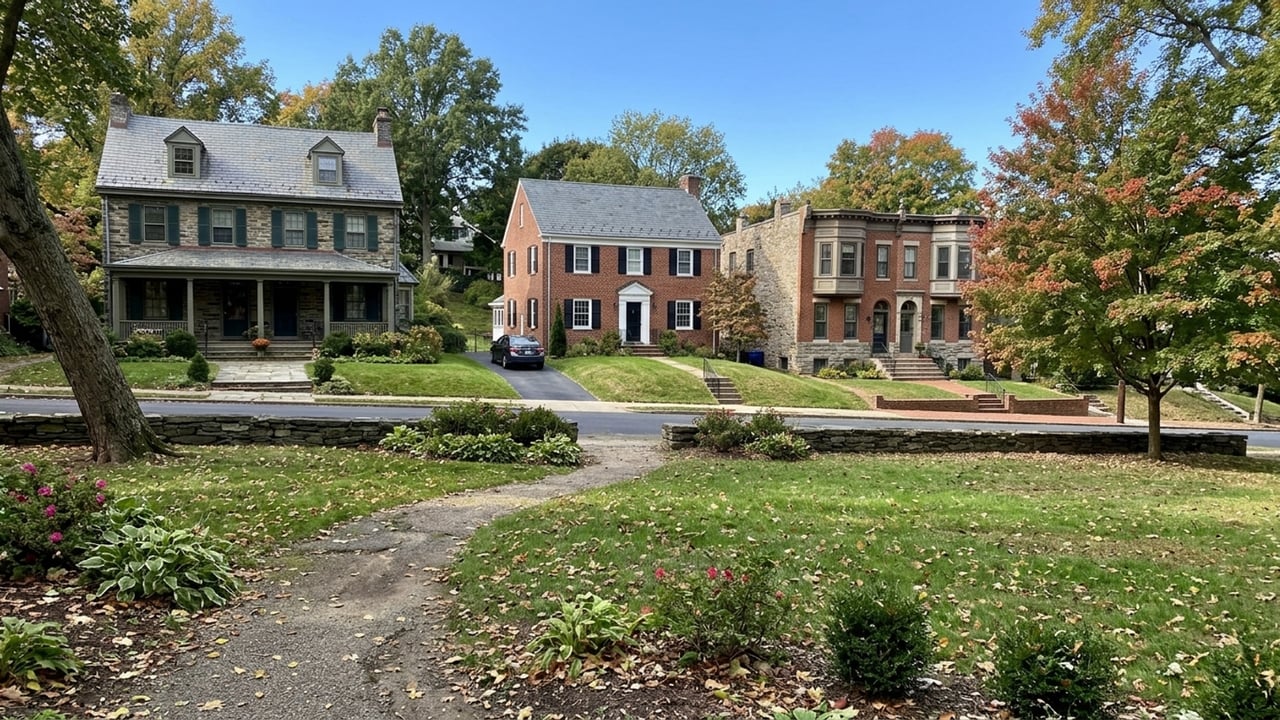
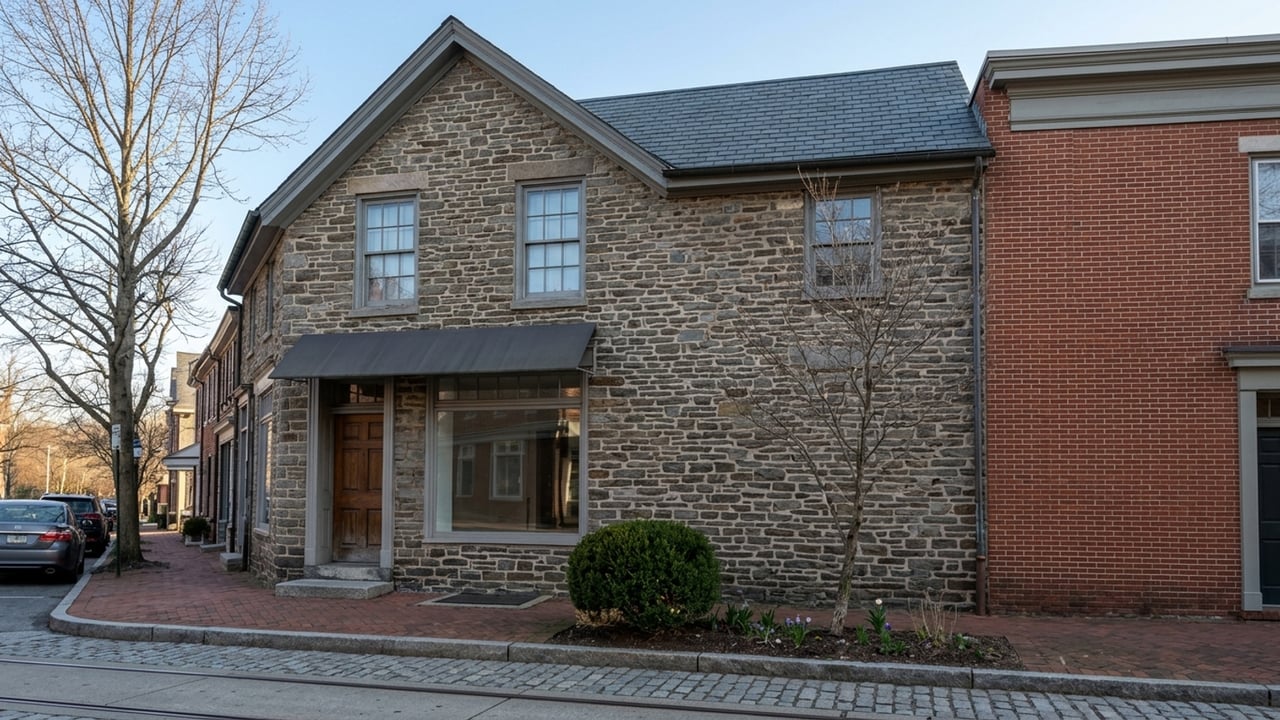
Chestnut Hill sits at the northwest edge of Philadelphia, defined by its stone houses, shaded avenues, and two commuter rail lines. The neighborhood's housing stock reflects a long timeline of development, stretching from an early 18th-century settlement to a planned 19th-century commuter hub.
Buyers looking at homes here are often drawn to this architectural record. The era in which a Chestnut Hill house was built dictates its size, its layout, and ultimately its price tag.
Key Takeaway
Chestnut Hill grew from a farm-and-mill village on Germantown Avenue into a planned railroad suburb, and those two eras still split its homes. Detached houses recently sold for about 2.7 times the townhouse median at nearly the same price per square foot (small samples, 90 days ending 2026-09-30). If you want the history at a lower entry price, start with the older attached and twin stock. If you want an estate-era detached house, budget for its size rather than a per-foot premium.
Who This Guide Is For
You are reading up on Chestnut Hill's past because you are weighing an older home here and want to know which era and type of house fits your budget and your appetite for historic-district rules.
What Is the History of Chestnut Hill?
Chestnut Hill's history is written into its price list. The village that grew along Germantown Avenue and the planned railroad suburb built around it produced homes so different in size that detached houses recently sold for a median $1,999,668 against $750,000 for townhouses. Yet they trade at nearly the same price per square foot: roughly $400 versus $389 (based on 11 and 17 sales in the 90 days ending 2026-09-30).
The neighborhood's timeline starts with early settlement in German Township and the creation of the Great Road. It then shifts to the arrival of the railroads, the area's consolidation into Philadelphia, and the modern preservation movement that protects its buildings today.
Where Chestnut Hill Is and How It Became Part of Philadelphia
The neighborhood sits at the city's northwest edge in Philadelphia County, bordered by the Wissahickon Valley and the Montgomery County line. It was originally part of Germantown Township, a land grant given by William Penn in 1683 to Protestant families from Holland and Germany.
The Act of Consolidation in 1854 dissolved Germantown Township and brought the area under the government of the City of Philadelphia. That matters for buyers: this is a city neighborhood with city services and Philadelphia's tax system, despite its suburban appearance. You can find more details about its location on our 19118 ZIP code page.
The suburban image sometimes misleads buyers who arrive expecting township-style rules. City zoning and Philadelphia Historical Commission reviews apply here.
Early Chestnut Hill: Farms, Mills, and the Great Road
Development began around 1704 at the intersection of Germantown Avenue and Bethlehem Pike, both originally Native American trails. Germantown Avenue served as the old road to the countryside, and a small village grew around it. The Detwiler House at 8220 Germantown Avenue, built in 1744, is considered the oldest surviving building in the neighborhood.
That early construction pattern left a legacy of compact, attached, stone-built housing near the avenue. It's part of why the attached stock today is smaller and lower-priced than the later suburban additions.
The oldest homes have the smallest footprints, the least original mechanical infrastructure, and the most scrutiny on exterior changes. You should read our historic home inspection guide before making an offer on an 18th-century property.
The Railroads and the Planned Suburb
The arrival of commuter rail transformed the village into a suburb. The Philadelphia, Germantown and Norristown Railroad built what is now the Chestnut Hill East line, extending it to the neighborhood in 1854. Then in 1884, the Pennsylvania Railroad opened a competing 6.75-mile line to what is now Chestnut Hill West.
Businessman Henry H. Houston backed the west-side railroad and used it to develop Wissahickon Heights, a planned community of large detached houses and institutions centered around the station. Later, his son-in-law George Woodward built European-inspired rental houses, renaming the development St. Martins and bringing the upper-middle class to the area.
This era created the neighborhood's sharp divide between massive detached houses and smaller attached stock. Estate-era detached homes carry estate-era scale in heating, roofs, stonework, and grounds. You can review our historic home insurance page to understand coverage options for these large properties.
Chestnut Hill in the 20th Century: Institutions and Mid-Century Landmarks
The 20th century added major institutions and modern architecture to the neighborhood. The Morris Arboretum began as a private summer estate in 1887 and officially opened to the public as a university-administered arboretum in 1933. Chestnut Hill College and Chestnut Hill Hospital also expanded their footprints during this time.
The area is a destination for modern-architecture history, not just colonial and Victorian designs. Louis Kahn's Margaret Esherick House, completed in 1961, sits on Sunrise Lane and is listed on the Pennsylvania Register of Historic Places.
Because the historic label here spans several centuries of styles, buyers should review our buying a historic home guide. Landmark-level modern houses are rare on the market and come with their own preservation scrutiny, so check a specific property's designation status rather than assuming it.
Preservation and the Historic District Today
The Chestnut Hill Conservancy leads the local preservation effort. Founded in 1967 as the Chestnut Hill Historical Society, the group completed a comprehensive survey in 1987 that nominated nearly 2,000 contributing buildings to the National Register of Historic Places.
National Register designation alone does not restrict demolition or alteration. In Philadelphia, only separate listing on the Philadelphia Register of Historic Places triggers regulatory review by the Historical Commission. There are individually locally-designated properties here, but there is no local historic district covering the neighborhood as a whole.
That distinction dictates what you can do with your property. You should review our historic district rules page, our guide to renovating a historic home, and our overview of historic tax credits. Exterior changes on designated homes can take longer and cost more under review. Ask the Historical Commission whether a specific address is locally designated, and ask the seller if the property carries a preservation easement.
What Chestnut Hill's History Means for Buying Today
Townhouses recently sold in a median 22 days at 101.7% of list price, while single-family homes took 35 days and closed at 104.6% of list (90 days ending 2026-09-30; 17 and 11 sales). Attached homes reward a buyer who is pre-approved and ready to move within weeks. Detached homes allow a little more time but often close above asking, which makes the list price a floor rather than a ceiling. The single-family median sale price jumped 63.9% year over year, but this likely reflects which large homes sold among the small 11-home sample, rather than a market-wide rise.
Your decision comes down to a few questions. Do you want a village-scale attached home, or a detached house on its own grounds? Are you comfortable with outside review of exterior changes such as windows, roofs, and additions? Is one architectural era the real priority, and will the house need work?
Small samples swing quarter to quarter, so ask for recent comparable sales of the same era and home type. You can check our housing market page, our pros and cons of living here, and our breakdown of neighborhoods by home type to weigh your options.
Where to Learn More About Chestnut Hill History
The Chestnut Hill Conservancy maintains archives and offers walking tours for those looking to research specific blocks. You can also request a property's nomination document or Conservancy file to confirm its construction date and architect rather than relying on a listing description.
Kristin McFeely's team at Compass can pull recent sales of homes from a specific era to help you compare values. Archival records cover designated and notable buildings far better than ordinary houses, so many homes will have thin files.
At a Glance
- All homes: median sale price $939,737, up 2.5% year over year (90 days ending 2026-09-30; based on 29 sales, so treat as a rough guide)
- All homes: median 24 days on market, 102.9% sale-to-list, 46.3% sold above list (90 days ending 2026-09-30; 29 sales)
- All homes: 2.9 months of supply, 27 homes in inventory, median $391 per square foot (90 days ending 2026-09-30)
- Single family: median sale price $1,999,668, up 63.9% year over year (90 days ending 2026-09-30; based on only 11 sales, so the jump likely reflects which large homes sold, not a market-wide rise)
- Single family: median $400 per square foot, 35 median days on market, 104.6% sale-to-list, 45.3% sold above list, 3.5 months of supply, 13 in inventory (90 days ending 2026-09-30; 11 sales)
- Townhouse: median sale price $750,000, up 24.5% year over year (90 days ending 2026-09-30; based on 17 sales)
- Townhouse: median $389 per square foot, 22 median days on market, 101.7% sale-to-list, 46.8% sold above list, 2.1 months of supply, 12 in inventory (90 days ending 2026-09-30; 17 sales)
Chestnut Hill History FAQs
How Did Chestnut Hill Get Its Name?
Chestnut Hill was named as early as 1704 for a small village at the intersection of Germantown Pike and Bethlehem Pike. The name likely derived from the many chestnut trees that encircled the hamlet. The area later spread over parts of the original German Township land divisions laid out by Germantown founders in 1683.
How Old Is Chestnut Hill?
Chestnut Hill was originally part of German Township, granted by William Penn in 1683 to thirteen Protestant families from Holland and Germany. The earliest recorded mention of the name "Chestnut Hill" is on a deed from 1704. Claims about the exact age of the neighborhood depend on whether you start from the land grant or the deed.
Is Chestnut Hill a Wealthy Neighborhood?
The neighborhood has a high entry point, with an all-homes median sale price around $939,737 (90 days ending 2026-09-30, based on 29 sales). Values span a wide range depending on the property type. You can check the at-a-glance list above or our housing market page for the split between single-family homes and townhouses.
Is Chestnut Hill a Good Neighborhood?
It depends on your needs. Buyers choose the area for its historic architecture, the Germantown Avenue commercial strip, and access to the Wissahickon Valley and two regional rail lines. You can read our pros and cons page to weigh the trade-offs of living here.
Is Chestnut Hill in Philadelphia, and What County Is It In?
Yes, Chestnut Hill is inside the City of Philadelphia and located in Philadelphia County. It was brought under the city's government by the Act of Consolidation in 1854. The neighborhood sits in ZIP code 19118, which you can read more about on our ZIP code page.
Is Chestnut Hill Safe?
The Chestnut Hill neighborhood is patrolled by the Philadelphia Police Department's 14th Police District. The City of Philadelphia publishes neighborhood and district-level crime incident data daily on the OpenDataPhilly website. You can look up incidents by block and time window, and you should compare the same time window across areas.
What Is the History of Chestnut Hill College?
Chestnut Hill College was founded in 1924 by the Sisters of Saint Joseph as a Catholic, four-year arts college for women. It was originally named Mount Saint Joseph College. The institution was renamed Chestnut Hill College in 1938.
What Is the History of Chestnut Hill Hospital?
Chestnut Hill Hospital opened on October 14, 1903, in two small houses with fourteen beds. The Court of Common Pleas of Philadelphia County granted its official charter on November 21, 1903.
Sources
- Redfin: Data Center
- American Planning Association: Great Places
- Wikipedia: Chestnut Hill East Branch
- Wikipedia: Philadelphia, Germantown and Chestnut Hill Railroad
- Philadelphia Magazine: Chestnut Hill Neighborhood Guide
- Pennsylvania General Assembly: Act of Consolidation
- Living Places: Chestnut Hill Historic District
- Chestnut Hill Conservancy: By-Right Development
- Chestnut Hill Conservancy: Advocacy
- Morris Arboretum: 90th Anniversary
- Chestnut Hill College: History
- University of Pennsylvania: Chestnut Hill Hospital Records
- OpenDataPhilly: Crime Incidents