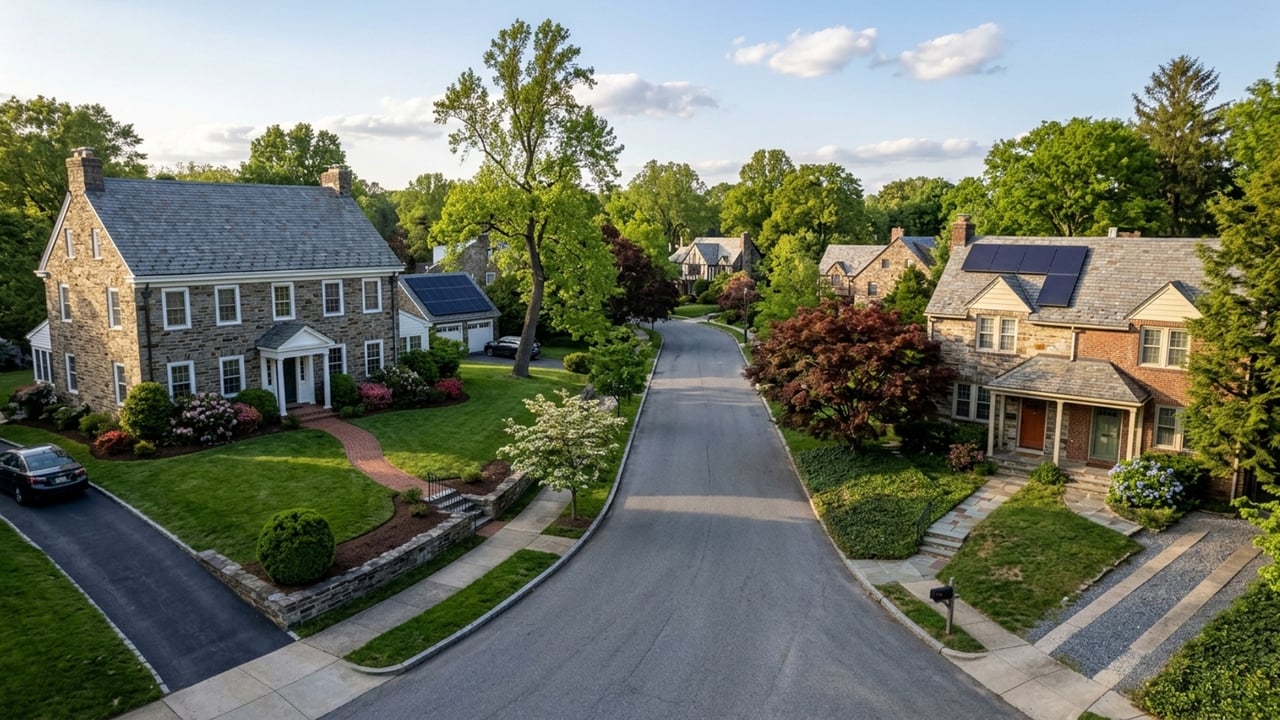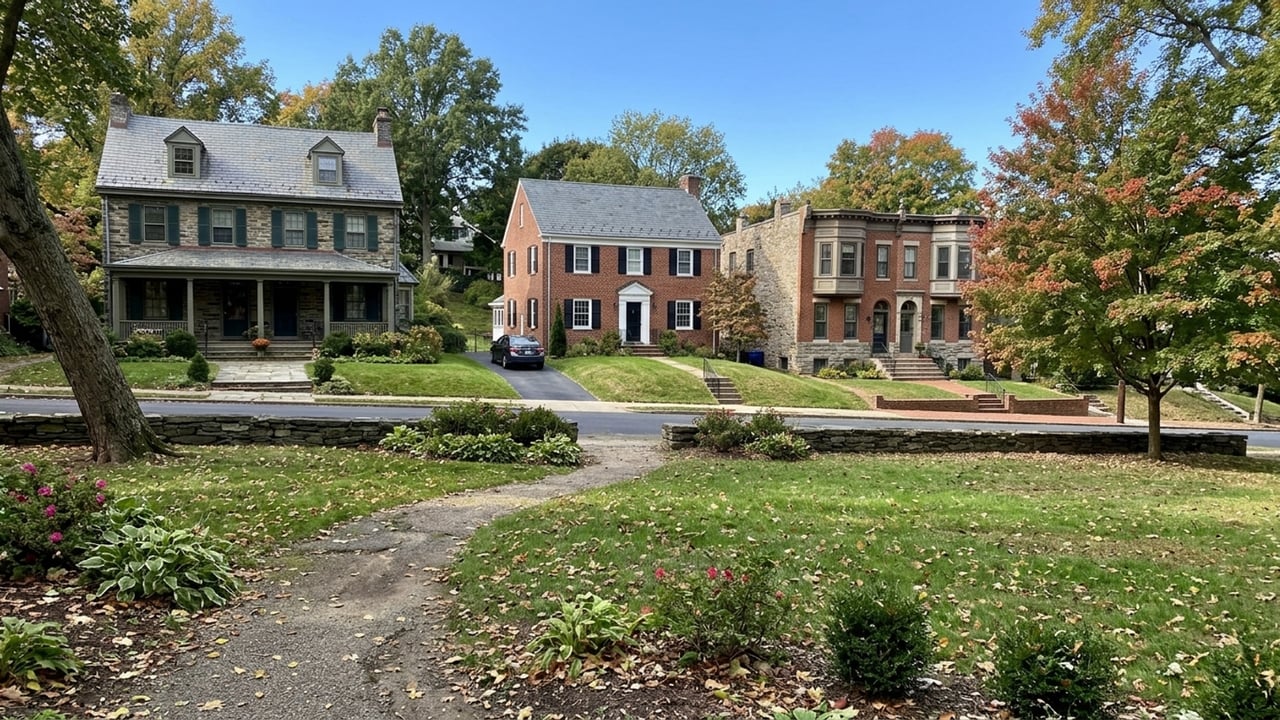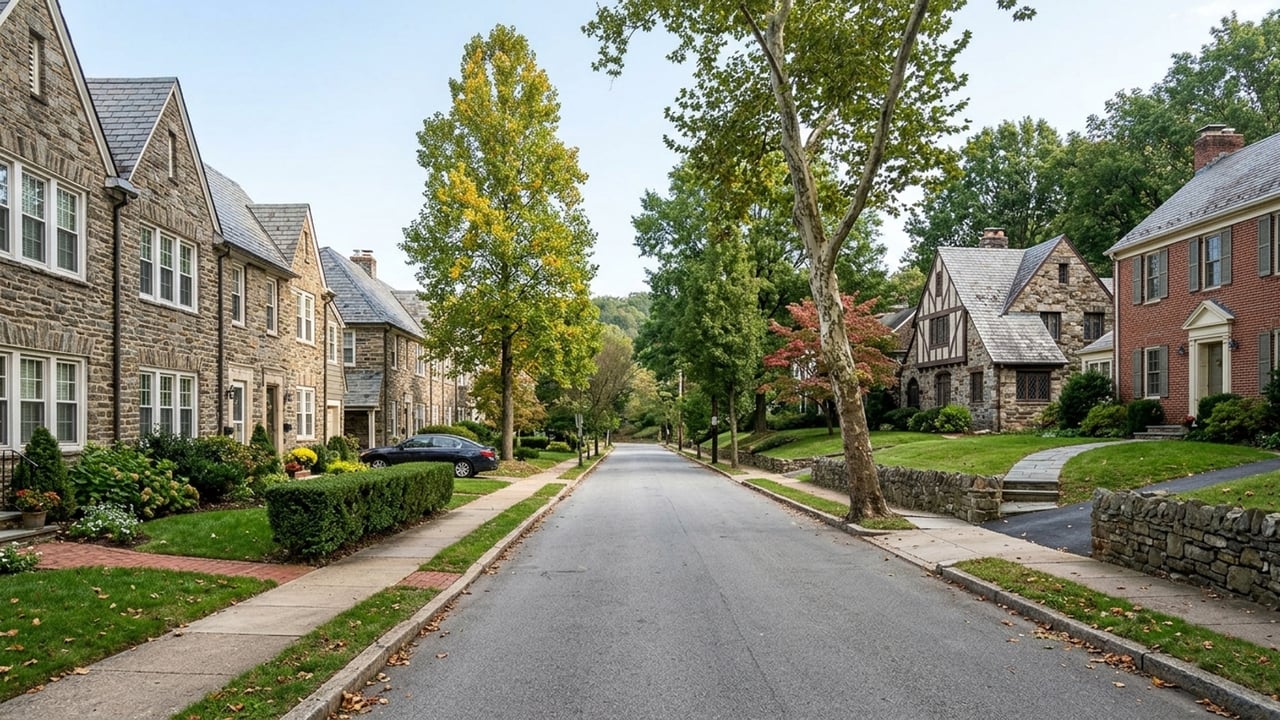
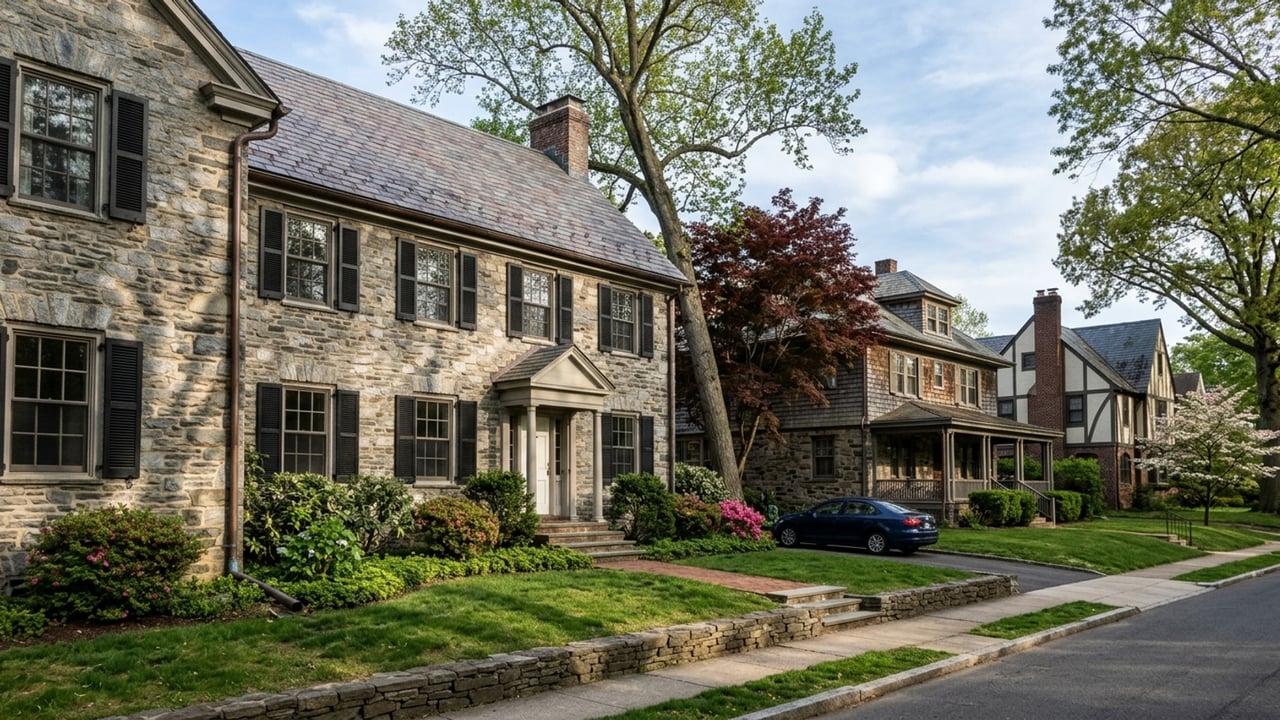
Chestnut Hill sits at the highest point in Philadelphia, reaching about 446 feet above sea level near Summit Street and Germantown Avenue. That elevation gives the neighborhood its name, but the weather up the hill behaves much like the rest of the city, bringing four distinct seasons that test the limits of older construction.
Freeze-thaw winter cycles and heavy summer downpours dictate how a stone, brick, or slate house holds up over time, and finding that wear before you buy is a major part of shopping for a home here.
Key Takeaway
Expect four distinct seasons in Chestnut Hill, and judge a house by how it handles the two hard ones: freeze-thaw winters that work water into stone and slate, and humid summers with heavy downpours. With 46.3% of homes selling above list in the 90 days ending September 30, 2026 (based on 29 sales), do your weather checks before you offer. If you want to carry a smaller roof and lot through winter, start with townhouses.
Who This Guide Is For
You're weighing a move to Chestnut Hill and want to know what each season brings and what the weather will ask of an older house before you commit to one.
What the Weather Is Like in Chestnut Hill
Philadelphia falls under the Köppen climate classification Cfa, placing it on the northern edge of the humid subtropical climate zone. For a buyer, Chestnut Hill's weather matters less as a forecast than as a maintenance load: freeze-thaw winters and heavy summer downpours test the stone, slate, and drainage of older houses. With homes selling at a median above list price and nearly half of all sales closing over asking in the 90 days ending September 30, 2026 (based on 29 sales), you need to find that weather wear before you offer, not try to bargain for it afterward.
Because Chestnut Hill sits higher than the rest of the city at 446 feet, some buyers expect drastically different conditions, but published climate normals for the area come from official recording stations like Philadelphia International Airport. For a daily look at upcoming rain or snow, the National Weather Service Mount Holly office provides point forecasts for specific addresses.
Chestnut Hill Weather by Season
Of the four seasons, winter and summer decide most of an owner's upkeep budget. Spring and fall offer the best touring windows, but the extremes of the year do the actual damage to historic properties.
Winter in Chestnut Hill
Winter temperatures frequently swing above and below the freezing mark, leaving snow and ice on steep old streets and long driveways. At Philadelphia International Airport, the 1991-2020 climate normal for January shows an average high of 41.3°F and a low of 26°F.
That continuous freeze-thaw cycle works water into mortar joints and under slate shingles, causing ice dams on older gutters. Masonry and roof condition matter just as much as a home's heating specifications. Ask the seller for the roof's age, its material, and the date of the last masonry repointing to gauge upcoming costs. If you need to replace a roof, changing materials on a historic house will likely require a review, so check the local historic district rules before you plan anything.
The deeper problem is that freeze-thaw damage to stone walls, chimneys, and slate roofs is slow and often invisible during a summer showing. Whatever a winter has already done is part of the price you pay, so it has to be found at inspection.
Summer in Chestnut Hill
Summer brings high humidity and heavy downpours that test gutters, grading, and basements. When daytime temperatures reach the 90s or triple digits with high humidity for two or more days, the city's Office of Emergency Management can declare a Heat Health Emergency due to the risk of dehydration and heat exhaustion.
Many older homes were built long before central air conditioning existed, making modern cooling and dehumidifying a major line item for buyers. Before making an offer, ask whether the house has central air, ducted mini-splits, or window units, and request a year of utility bills to see the true cost of running them. You'll also want to review your options for renovating a historic home if you plan to retrofit an HVAC system.
What you give up with a dry-weather showing is any real sense of how the basement handles a two-inch downpour. Damp basements and overwhelmed downspouts only reveal themselves in storm season.
Storms, Flooding, and Trees in the Neighborhood
Tropical storm remnants produce some of the region's heaviest rain events, pushing local drainage systems hard. The Wissahickon Creek runs along the neighborhood's western edge, so if you're looking at properties on a slope or near the water, check the address on the FEMA Flood Map Service Center rather than relying on a listing's description.
Mature trees are a defining part of the streetscape here, but they're also a real hazard to roofs and power lines during high winds. Under Philadelphia Parks & Recreation rules, the city manages all street trees and handles planting, pruning, and removal based on hazard evaluations. You can't do major work yourself; even if you hire a certified arborist, you must obtain a permit from the Street Tree Management Division before touching a street tree. It's worth asking the seller or neighbors how often the power has gone out in storms and whether the house has a generator.
For properties that see water backing up through basement fixtures during wet weather, the Philadelphia Water Department offers a Basement Backup Protection Program. To be eligible, a property's water bill must be current or on a payment agreement, and all outstanding city violations must be resolved. Ask your insurer whether water-backup and tree-damage coverage are included in your policy or if you need a specific rider to insure a historic home against storm damage.
How Weather Affects Buying a Home
On a home listed at $1,000,000, that median sale-to-list ratio means you can expect to pay about $1,029,000. Any roof, masonry, or drainage repair you discover after closing comes on top of that.
The time you'll have to investigate depends on what type of property you're targeting. Single-family homes sat on the market for a median of 35 days, while townhouses moved in just 22 days (based on 11 and 17 sales, respectively). A detached house might leave you a little more time to bring in a roofer or mason before you offer. Townhouses don't give you that cushion.
You can read more about what to look for when inspecting stone, slate, and drainage to prepare for these tight timelines. The broader housing market figures and a dedicated offer strategy guide can also help you set expectations and prepare for negotiations.
At a Glance
Recent market data for Chestnut Hill:
- Median sale price, all homes: $939,737, up 2.5% year over year (90 days ending 2026-09-30; based on 29 sales, a small sample)
- Median sale price, single family: $1,999,668 (90 days ending 2026-09-30; based on 11 sales). The 63.9% year-over-year change rests on so few sales that it should be read with caution.
- Median sale price, townhouse: $750,000, up 24.5% year over year (90 days ending 2026-09-30; based on 17 sales)
- Median days on market: 24 for all homes, 35 for single family, 22 for townhouses (90 days ending 2026-09-30)
- Median sale-to-list ratio: 102.9% for all homes, 104.6% for single family, 101.7% for townhouses (90 days ending 2026-09-30)
- Share sold above list price: 46.3% of all homes, 45.3% of single family, 46.8% of townhouses (90 days ending 2026-09-30)
- Months of supply: 2.9 for all homes, 3.5 for single family, 2.1 for townhouses (90 days ending 2026-09-30)
- Homes for sale: 27 total, 13 single family, 12 townhouses (90 days ending 2026-09-30)
- Median price per square foot: $391 for all homes, $400 for single family, $389 for townhouses (90 days ending 2026-09-30)
Best Time of Year to Tour and Inspect a Home
Spring and fall provide the most revealing conditions for walking through an older house. A spring tour scheduled after a heavy rain shows gutters, grading, and basements in action, revealing how a house handles water.
Fall showings reveal the tree canopy, the leaf load on roofs and gutters, and how well the heating system functions as temperatures drop. Schedule exterior masonry or paint inspections before the first frost, which typically arrives in November (see the FAQs below for exact dates). Winter tours expose ice dams and heating drafts, while midsummer showings can hide drainage problems completely under dry ground.
Real estate data feeds cover a rolling 90-day window, so seasonal listing patterns vary. Ask your agent when inventory typically peaks in the neighborhood, since weather influences when sellers choose to list.
Is the Local Weather a Good Fit for You?
Deciding to buy here comes down to your tolerance for seasonal upkeep and the type of house you want to maintain. If you're comfortable handling snow, fallen leaves, and storm limbs on a detached lot, a single-family home makes sense. If a smaller roof and lot would suit you better, townhouses carry less exterior maintenance.
The property's specific location and materials matter too. If the house sits on a slope toward the Wissahickon Creek, checking the FEMA map is a necessary step, not an optional one. A slate roof, stone walls, original gutters, or a fieldstone basement will produce a very different maintenance budget than a modern build. And think about when you're touring: a showing in a dry spell or midsummer means you might miss active leaks entirely.
You can weigh these factors alongside the broader pros and cons of living in the area. If you want to talk through how a specific house has weathered past seasons before writing an offer, reach out and we can review the property together.
Chestnut Hill Weather FAQs
How Much Snow Does Chestnut Hill Get in a Year?
Annual snowfall totals vary widely from year to year across the Philadelphia region. Because there's no official station tracking snow exclusively for the neighborhood, check the NOAA NCEI 1991-2020 climate normals for the closest Philadelphia monitoring stations.
How Much Rain Does Chestnut Hill Get per Year?
Localized precipitation data relies on broader city metrics. You can look up the average annual precipitation and the wettest months for the area through the NOAA NCEI 1991-2020 climate normals. That data reinforces why checking a home's drainage and gutters matters so much.
Is Chestnut Hill Colder than the Rest of Philadelphia?
It depends on the exact day and elevation, but official published normals are taken at the Philadelphia International Airport station rather than up the hill. To compare temperatures, check the official NWS station data for Northwest Philadelphia versus the airport. The neighborhood sits at 446 feet, but official records don't track a separate climate normal just for this zip code.
What Planting Zone Is Chestnut Hill In?
ZIP code 19118 falls in the 2023 USDA Plant Hardiness Zone 7b, which has an average annual extreme minimum temperature of 5°F to 10°F. This zone designation uses 1991-2020 weather data and determines which perennials and trees will survive the winter in your yard.
When Is the First Frost in Chestnut Hill?
Based on NOAA's 1991-2020 Climate Normals for the nearby Philadelphia/Franklin Institute station, the average first fall frost occurs on November 11. The average last spring frost is April 4, giving the area a 220-day growing season. Those dates matter for planting gardens and for scheduling exterior masonry or paint work on your house.
Have Tornadoes Hit Chestnut Hill or Northwest Philadelphia?
Yes, tornadoes occasionally affect the broader county. NOAA's Storm Events Database lists 12 recorded tornado events in Philadelphia County between 1950 and the present, including an F2 in 1998 that tracked through Bustleton/Byberry and others rated F0-F2 in various years. You can look up the complete historical record through the National Centers for Environmental Information database.
Sources
- Redfin: Data Center
- Wikipedia: Philadelphia
- National Weather Service: KPHL Climate Normals
- City of Philadelphia: Heat Health Emergency
- City of Philadelphia: Street Tree FAQ
- City of Philadelphia: Basement Backup Protection Program
- PlantMaps: 19118 Hardiness Zone
- Old Farmer's Almanac: Frost Dates
- NOAA: Storm Events Database