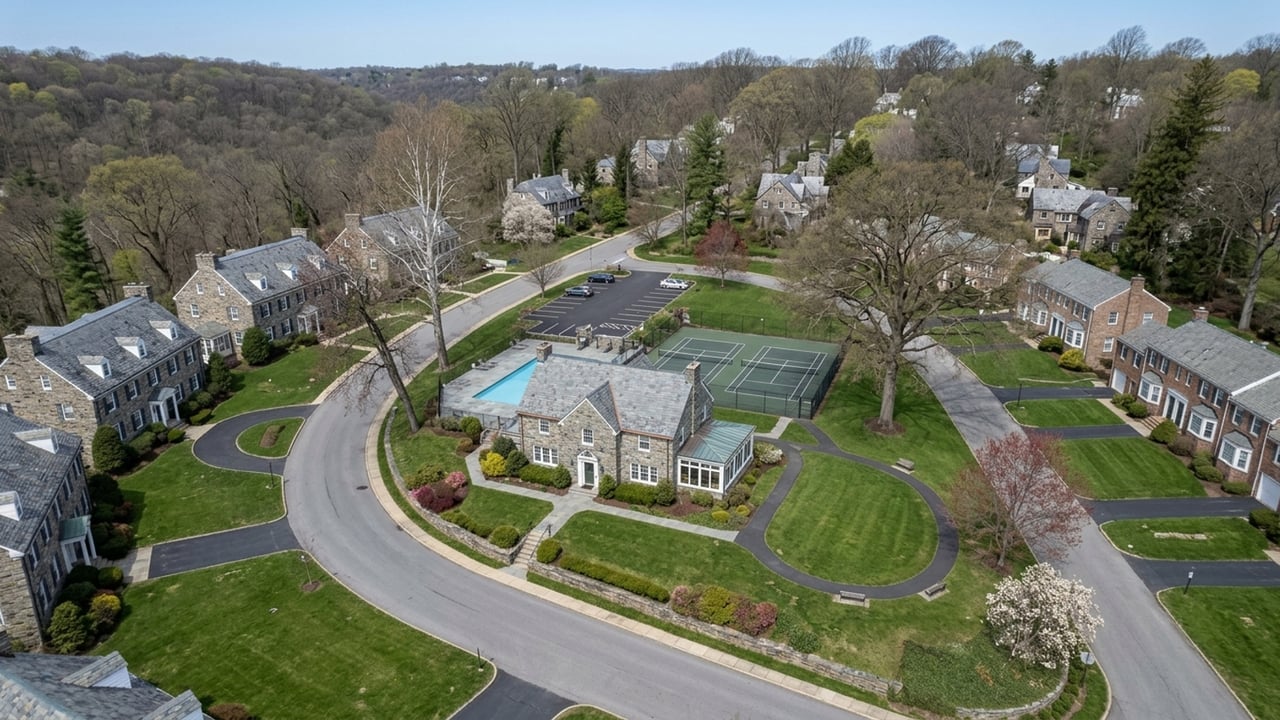
Recent market data shows single-family homes in Chestnut Hill selling for a median of around $1.11 million. That built-up equity in the 19118 ZIP code opens multiple doors for the next phase of life.
The decision usually comes down to trading a larger house for a smaller townhouse nearby or moving into a dedicated community with on-site services. The costs, timelines, and available care levels separate a plan from a guess.
Key Takeaway
If you own a single-family home in Chestnut Hill, the current market favors selling it and buying a townhouse in the neighborhood. Single-family supply is tight while townhouse prices are falling, and based on recent medians, that move frees about $571,000 before costs. If you want care on site as your needs change, put that equity toward a continuing care retirement community instead, once you have compared its entrance fee and refund terms.
Who This Guide Is For
You own a home in or near Chestnut Hill and are deciding whether to move into a retirement community or sell and buy something smaller nearby, and how to pay for and time either move.
What Your Chestnut Hill Home Can Fund
Chestnut Hill's own sales data makes a compelling case for selling the house before you choose your next step. For the 90 days ending October 31, 2026, single-family homes sold at a median of $1,111,125 with just 1.6 months of supply, based on 14 sales. During that same window, the median townhouse sale price fell 19.4% year over year to $539,984 with 2.7 months of supply, based on 21 sales. These are small sample sizes, so a few sales can swing the median considerably.
Selling into the tight part of the market and buying into the looser part creates a significant gap. A house selling near the single-family median, followed by a townhouse purchase near the townhouse median, leaves roughly $571,000 in freed equity. That balance gets reduced by commission, moving costs, and the combined Philadelphia realty transfer tax, which sits at 4.578% for 2026.
A long-held house may also carry a gain above the federal exclusion. That exclusion allows qualifying married couples filing jointly to exclude up to $500,000 from income. Ask a tax advisor how it applies to your specific sale; this is not tax advice. The net proceeds can either fund a smaller property in the neighborhood or cover the entrance fee at a continuing care retirement community.
Questions to Narrow Your Options
- Do you want care available on site if your needs change, or do you mainly want less house to maintain? Care on site points to Continuing Care Retirement Communities (CCRCs) and Assisted Living and Personal Care Homes. Less upkeep points to Buying a Townhouse in Chestnut Hill and Independent Living Communities.
- Would you rather pay a large upfront fee in exchange for more predictable future care costs, or keep your equity liquid and pay month to month? Upfront points to the CCRC section, while month to month points to Independent Living Communities.
- Does your household income fall under federal or city program limits? If so, start with Income-Restricted Senior Apartments and the tax freeze FAQ.
- Do you need the proceeds from your house before you can pay for the next place? If yes, read Selling Your Home First. If you can carry both for a while, read Securing Your Next Home First.
Staying in Chestnut Hill
Staying in the neighborhood is practical even without a car. The Chestnut Hill East and West lines both connect to Center City in roughly 40 to 45 minutes via Regional Rail. Review the pros and cons of living in Chestnut Hill to confirm the neighborhood fits your long-term lifestyle before you commit to a plan.
Buying a Townhouse in Chestnut Hill
Townhouse prices fell faster than any other home type here in late 2026, giving a downsizing buyer room to negotiate. The median price per square foot for a townhouse was $370 over the 90 days ending October 31, 2026, only about $30 below the median for single-family homes. The savings come from buying less space, not cheaper space.
This property type works well if you want lower upkeep without leaving the 19118 ZIP code. Explore the home types by area within Chestnut Hill to see where townhouses are concentrated. The practical catch: townhouses here are often multi-story with bedrooms upstairs. Check for a first-floor bedroom and full bath, and ask the association for current dues and rules before you make an offer.
Adapting Your Current Home
Modifying your house is the main alternative if leaving isn't what you want. Adding first-floor living spaces, grab bars, and stair lifts can make an older property functional for the long term. Philadelphia runs an Adaptive Modifications Program that can help pay for ramps and stair lifts for eligible homeowners. The city's senior real estate tax freeze is covered in the FAQ section below.
Older Chestnut Hill houses often have narrow stairs and multiple levels that complicate renovations. In the historic district, exterior changes such as ramps may require approval. Review the historic district rules for exterior changes and the guidelines for renovating a historic home to see what accessibility modifications are permitted, and confirm with the Philadelphia Historical Commission before hiring a contractor.
Retirement Communities Near Chestnut Hill
Moving into a community trades home maintenance for bundled services, but the financial structures vary widely. Facilities range from independent apartments with basic amenities to campuses offering full medical support. Kristin McFeely's team can help you plan the sequence of your sale once you've settled on a facility type.
Continuing Care Retirement Communities (CCRCs)
This is where equity from a house sale most directly applies. CCRCs require an entrance fee plus a monthly fee in exchange for a path from independent living to care on the same campus. Contracts typically fall into extensive, modified, or fee-for-service categories, and the differences between them are significant.
In Pennsylvania, CCRCs are licensed by the Insurance Department, not the health department. The state requires providers to hand you a disclosure statement before you sign, and grants a seven-day rescission period to cancel without penalty. The Pennsylvania Insurance Department maintains an online search tool to find licensed providers near 19118.
Entrance-fee refunds depend entirely on the contract and can shrink to little or nothing over time. Popular communities may also have waitlists, so a well-timed house sale can still leave you waiting for a unit. Ask any CCRC for its current disclosure statement, contract type, and entrance-fee refund schedule before you pay a deposit.
Independent Living Communities
Independent living is the rental counterpart to a CCRC: no buy-in, just a monthly fee that may bundle meals, housekeeping, and activities. That structure keeps your house proceeds liquid and invested rather than tied up in an entrance fee.
What you give up is any guarantee of future medical support. Care is generally not included, and if your needs grow, you may have to move again. Monthly fees typically rise each year, so ask every community for its fee history over the last three years and exactly what the payment covers.
Assisted Living and Personal Care Homes
These facilities are designed for residents who need help with daily activities right now. Pennsylvania licenses personal care homes and assisted living residences as two distinct categories with different requirements. You can verify a facility's license status in the Pennsylvania Department of Human Services directory.
This care is largely private pay. Medicare does not cover room and board, so house equity and personal income usually carry the cost.
Income-Restricted Senior Apartments
Affordable senior buildings operate through federally subsidized or city-supported programs in Northwest Philadelphia. The Philadelphia Housing Authority designates Emlen Arms in 19119 as a senior-only development, and Newcourtland operates a HUD Section 202 property nearby. Eligibility rests on income limits, not just age, and residents typically pay a set percentage of their income toward rent.
Waitlists can run long. Applying early, before you sell your house, matters more than any other single step here. Ask each income-restricted building for its current waitlist length and how the proceeds from a home sale count toward their income limits.
Age-Restricted 55+ Communities
Federal law allows specific condominium or townhouse developments to restrict occupancy by age. These communities offer age-restricted housing without the bundled medical services of a CCRC. A search of the immediate 19118 area shows no major 55+ condo developments directly inside Chestnut Hill, so buyers looking for this option will need to look at neighboring townships.
The tradeoff is a narrower resale market: the age restriction limits your future buyer pool. Association rules on guests and under-55 occupants are set by each community individually. Ask for the written age-verification policy and the rules on younger occupants before you buy.
How to Time Your Sale and Move
Townhouses move about twice as fast as single-family homes in this area, which creates a real sequencing challenge for downsizers. How you coordinate your sale with your next purchase determines whether you'll need temporary housing, bridge financing, or both.
Selling Your Home First
Selling first gives you a firm budget for an entrance fee, a townhouse purchase, or an independent living deposit. Chestnut Hill single-family homes have been selling for about 99% of their list price, but the median sale took 48 days during the 90 days ending October 31, 2026. Plan for weeks, not days. Review selling and pricing a Chestnut Hill home to prepare your listing.
The gap between your closing and your next move-in needs a plan. Ask the buyer for a rent-back agreement, or confirm the community's move-in date in writing before you accept an offer.
Securing Your Next Home First
Waiting to sell first can cost you the right property. Townhouses saw a median of just 25 days on market recently, and nearly 3 in 10 sold above list price despite overall prices falling year over year. Bridge financing or a sale contingency are the standard tools to secure a property before your current house sells. Ask a lender about bridge loans before making a contingent offer, and review buying and making offers in Chestnut Hill for local strategies.
The catch is carrying two homes simultaneously: two tax bills, two insurance policies, two sets of utilities until the house sells. A contingent offer is also a weaker position against buyers paying above list price.
Chestnut Hill Home Prices at a Glance
- Median sale price, all homes: $757,138, down 16.6% year over year (35 sales, 90 days ending Oct 31, 2026)
- Median sale price, single-family: $1,111,125, down 9.3% year over year (based on only 14 sales, 90 days ending Oct 31, 2026; treat with caution)
- Median sale price, townhouses: $539,984, down 19.4% year over year (based on only 21 sales, 90 days ending Oct 31, 2026; treat with caution)
- Median days on market: 43 all homes, 48 single-family, 25 townhouses (90 days ending Oct 31, 2026)
- Sale-to-list price: 99.3% all homes, 99.2% single-family, 99.4% townhouses (90 days ending Oct 31, 2026)
- Share sold above list price: 29.3% all homes, 28.5% single-family, 29.7% townhouses (90 days ending Oct 31, 2026)
- Months of supply: 2.3 all homes, 1.6 single-family, 2.7 townhouses (90 days ending Oct 31, 2026)
- Homes for sale (inventory): 27 all homes, 8 single-family, 18 townhouses (90 days ending Oct 31, 2026)
- Median price per square foot: $382 all homes, $400 single-family, $370 townhouses (90 days ending Oct 31, 2026)
Review the full Chestnut Hill housing market data and outlook for more details, and reach out to Kristin McFeely's team for help analyzing your property's value.
Chestnut Hill Retirement Communities FAQs
What Are Some Good 55+ Communities Near Chestnut Hill?
The Pennsylvania Insurance Department lists Cathedral Village as a Continuing Care Retirement Community (CCRC) near Chestnut Hill in Northwest Philadelphia. For income-restricted options, Emlen Arms in 19119 is a senior-only development (see Income-Restricted Senior Apartments above), and Newcourtland operates a HUD Section 202 property nearby. Tour more than one community and request each disclosure statement before making a commitment.
How Much Does It Cost to Live in a Retirement Community Near Chestnut Hill?
Cathedral Village filed its 2026 Disclosure Statement with the Pennsylvania Insurance Department outlining residency investments and monthly fees effective January 1, 2026. Review that disclosure statement for current figures, and see the section on what your Chestnut Hill home can fund to see how your sale proceeds can offset these community fees.
What Is the 80/20 Rule in a 55+ Community?
Under the Housing for Older Persons Act, at least 80% of a community's occupied units must have at least one resident who is 55 or older. The community must also publish and follow age-verification policies to maintain this exemption to the Fair Housing Act. The association decides how to use the remaining 20% of its units.
Is It Cheaper to Live in a 55+ Community Than to Stay in Your Chestnut Hill Home?
It depends entirely on what the community fee replaces. List your current monthly property tax, insurance, utilities, and upkeep, then weigh that total against a community's monthly fee and what it covers, such as meals, maintenance, and care. Entrance fees at CCRCs like Cathedral Village are separate from these monthly costs and need to be factored in on their own.
Can My Adult Daughter Live With Me in a 55+ Community?
Under the Housing for Older Persons Act, a community may allow some residents under 55 as long as it meets the 80% occupancy test. Whether an adult child can live with you, and for how long, is set by each community's own rules. Ask for the written occupancy and guest-stay policy before buying or signing a lease.
Can a 54-Year-Old Buy in a 55+ Community?
Yes, because federal law measures who occupies the unit, not who owns it. Some communities allow under-55 owners or co-occupants within their remaining 20% allowance, while others bar them entirely. Ask the community's association for its minimum-age policy in writing to confirm.
Does Medicare Pay for Assisted Living in Pennsylvania?
Medicare does not cover long-term room and board or ongoing custodial care in an assisted living facility. It may still pay for certain covered medical services you receive while living there, such as doctor visits or home health care. For eligible residents, Pennsylvania's Community HealthChoices Medicaid program can pay for certain long-term services in a licensed facility, though it does not cover room and board.
Is Chestnut Hill Part of Philadelphia?
Yes, Chestnut Hill is a neighborhood within the City of Philadelphia and Philadelphia County, covering the local Chestnut Hill ZIP code of 19118. This means eligible residents can apply for the City of Philadelphia's Senior Citizen Real Estate Tax Freeze. For 2026, applicants must be at least 65 years old with a household income not exceeding $33,500 for a single person or $41,500 for a married couple. Apply through the city's revenue department by September 30, 2026.
Sources
- Redfin: Data Center
- Pennsylvania Insurance Department: Continuing Care Retirement Community Search
- Pennsylvania General Assembly: Continuing-Care Provider Registration and Disclosure Act
- Pennsylvania Insurance Department: Cathedral Village 2026 Disclosure Statement
- Philadelphia Housing Authority: Senior-Only Developments
- Code of Federal Regulations: 24 CFR 100.305 Housing for older persons
- National Council on Aging: Does Medicare Pay for Assisted Living?
- Pennsylvania Health Law Project: Medicaid Can Help Pay for Assisted Living in Pennsylvania
- City of Philadelphia: Apply for the low-income senior citizen Real Estate Tax freeze
- SEPTA: Chestnut Hill East Line Schedule
- Houwzer: Philadelphia Transfer Tax
- IRS: Publication 523, Selling Your Home