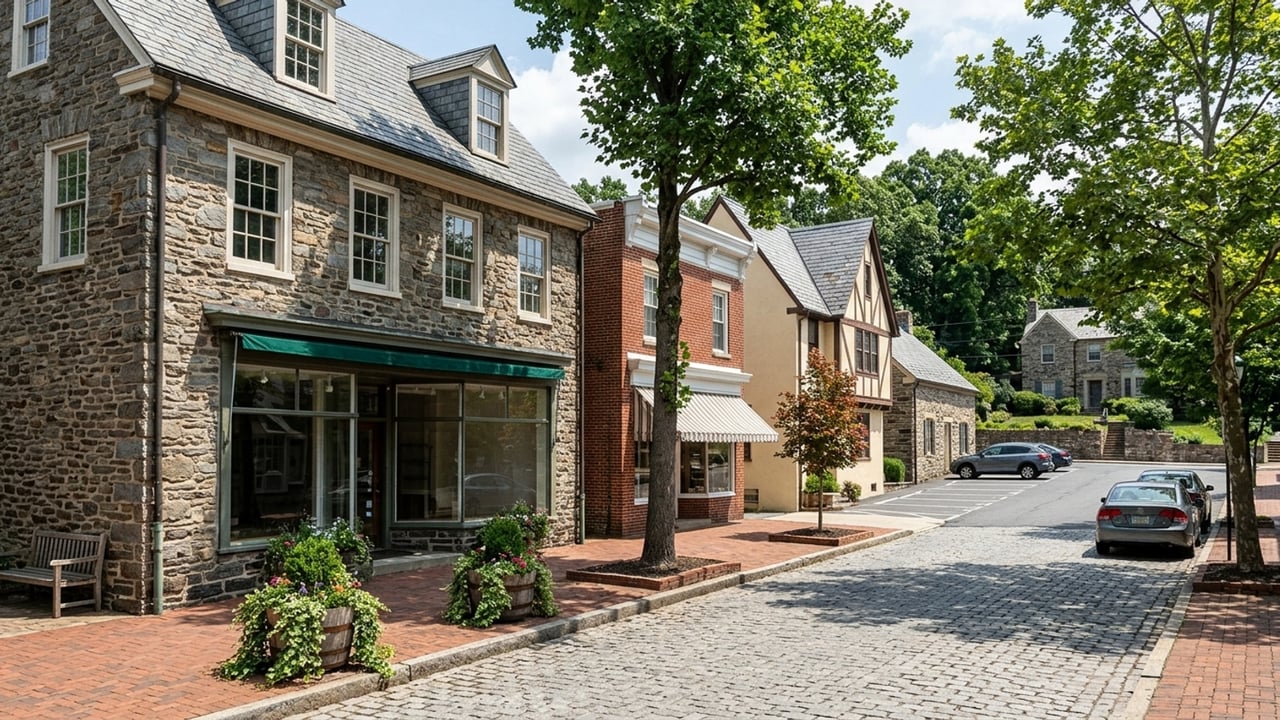
Chestnut Hill sits in the northwest corner of Philadelphia, PA, operating as a residential neighborhood rather than a standalone commercial center. Buyers moving here usually work somewhere else in the city or the broader metro area.
Commute times, city tax obligations, and how far a paycheck stretches toward a home purchase all shape the budget calculation here. The neighborhood's inventory consists mostly of townhouses and historic detached homes, and choosing between them comes down to your household income and how much space your daily routine requires.
Key Takeaway
Chestnut Hill works best if your job is in Center City or University City, because two SEPTA Regional Rail lines start in the neighborhood and few jobs are located here. Townhouses are most of what sells, at a median of $750,000 over the 90 days ending September 30, 2026 (based on 17 sales), so start there if your income won't stretch further. If you need a detached house, plan on a much higher price bracket and, for a suburban job, a car commute.
Who This Guide Is For
You're weighing a job offer or a daily commute against buying a home in Chestnut Hill and need to know whether the location and the prices fit how and where you work.
What the Job Market Is Like for Chestnut Hill Residents
Chestnut Hill is a place people live while working elsewhere, not a job market of its own. Two SEPTA Regional Rail lines start in the neighborhood and run to Center City and University City, which is where the region's largest employers cluster. The top employers in Philadelphia County for the first quarter of 2026 include the University of Pennsylvania, the City of Philadelphia, the federal government, the School District of Philadelphia, CHOP, and Jefferson Health.
Townhouses and detached houses sell for nearly the same price per square foot here, so the real job question for a buyer is how much space their income buys. You're not deciding whether a cheaper kind of home exists. You're evaluating the commute, the taxes, and the lifestyle trade-offs of living in this specific zip code.
Deciding If Chestnut Hill Fits Your Job
Most Chestnut Hill buyers commute to Center City, University City, or the Montgomery County suburbs. If your workplace is near a Regional Rail stop in Center City or University City, start your search with homes within walking distance of the Chestnut Hill East or Chestnut Hill West station. Both lines begin in the neighborhood, so the walk to the station is the part of the commute you control.
If you'll work for an employer outside the city or from home, review the local wage tax rules before you budget. Philadelphia taxes residents' wages wherever they work. For buyers looking to purchase near the neighborhood's median price, townhouses are the practical starting point: they made up 17 of 29 recent sales. If you want a detached house with room for a home office, you'll need a higher household income and should plan to move quickly on the limited inventory.
Commuting from Chestnut Hill to Work
Nearly all of Chestnut Hill's 19118 zip code relies on two Regional Rail lines and nearby highways for daily commutes. Commuters heading into the city's commercial core typically ride the train, while those working in the suburbs or from home face a different set of daily logistics.
Your destination dictates which transit option or driving route makes sense. Ride times vary, so walk or time the route from a specific address to the nearest station before you count on any door-to-door estimate.
Center City Offices
Two separate Regional Rail lines begin in Chestnut Hill, so commuters board at the start of the line. The Chestnut Hill East Line runs 12.2 miles to Center City stations like Jefferson, Suburban, and 30th Street, with weekday trains arriving roughly every 35 to 60 minutes.
The main choice is which station is closer to your home, since the two lines take different routes through the city. Service thins out off-peak and on weekends, so late nights or irregular hours can mean long waits. Check SEPTA's current weekday and weekend timetables for Chestnut Hill East and West before counting on a specific ride time.
University City Hospitals and Universities
University City's large medical and university employers sit near 30th Street Station. The trip is the rail ride plus the last leg from 30th Street to the campus or hospital entrance, and that final walk or bus ride can add real time to what looks like a short commute on paper.
Time the full door-to-door trip to your workplace, including that last stretch. Shift workers starting before the first train or ending after the last one may end up driving regardless.
Montgomery County Office Parks
For jobs in suburban employment centers, Chestnut Hill's location on the city's northwest edge shortens the drive compared with most Philadelphia neighborhoods. It's approximately 5.7 to 6.3 miles by car from Chestnut Hill to the Plymouth Meeting Mall area, which takes about 11 to 12 minutes in normal conditions.
Rail doesn't serve most suburban office parks, so plan on a car commute. The catch is that living in Chestnut Hill still means paying Philadelphia's resident wage tax on a suburban paycheck.
Working from Home
For remote and hybrid workers, the commute question becomes a space question. Townhouses and detached houses cost about the same per square foot here, so a dedicated office is a matter of buying more square feet, not a different property type.
Confirm internet providers and speeds at the specific address before you commit. Remote work doesn't change the tax picture: Philadelphia residents owe the resident wage tax even when the employer is in another state, and an out-of-city employer may not withhold it.
Major Employers in Chestnut Hill
While most residents commute out, a few large institutions and a commercial corridor do offer jobs physically located in the neighborhood. These represent a small share of the area's overall employment, and the roles range from healthcare and higher education to retail and hospitality. Check employer career pages directly for current openings rather than assuming a local position will surface on its own.
Chestnut Hill Hospital
Chestnut Hill has its own community hospital, part of a larger Philadelphia health system. As of August 2025, Temple University Health System manages and owns 80% of the 148-bed facility, with the Philadelphia College of Osteopathic Medicine owning the remaining 20%.
This is the neighborhood's main walk-to-work option for clinical and support roles. A single community hospital offers a narrower range of specialties than the big academic medical centers, though, so many healthcare careers still mean commuting to University City or Center City.
Chestnut Hill College and Morris Arboretum & Gardens
The arboretum on the neighborhood's edge belongs to the University of Pennsylvania, so some Penn jobs are located in Chestnut Hill rather than University City. Morris Arboretum & Gardens is a 92-acre historic public garden and educational institution operated by Penn Business Services.
These institutions offer roles in faculty, administration, horticulture, education, and visitor services. Both are mid-sized employers with limited openings at any given time.
Germantown Avenue Shops and Restaurants
The commercial corridor is the neighborhood's retail and hospitality employer base, consisting mostly of independent shops, restaurants, and local services. These businesses often hire for part-time and hourly roles. Those positions suit a second income or a nearby supplemental job, but they rarely support a mortgage at Chestnut Hill prices on their own.
Philadelphia Wage Tax for Chestnut Hill Residents
Because Chestnut Hill is inside Philadelphia, residents pay the city's resident wage tax on their earnings regardless of where their office is located. For fiscal year 2026, that rate is 3.74%.
If you work for an employer outside the city, they may not be required to withhold this tax. When no wage tax is withheld, Philadelphia residents must file and pay the Earnings Tax themselves. Ask your employer whether it withholds the tax, and if not, confirm your filing obligations with the Department of Revenue or a tax professional.
For a suburban or remote job, this means your take-home pay is lower than an otherwise identical suburban address would deliver. Factor that gap into your housing budget before you settle on a number.
Townhouse or Single-Family Home: What Your Income Buys
Townhouses and single-family homes in Chestnut Hill sell for nearly identical prices per square foot, which means you're paying for the amount of space rather than the style of the building. The neighborhood's inventory splits into two distinct price brackets based on property type, and where you land depends on what your income can carry.
Townhouses
Attached homes are the main way into Chestnut Hill on a household income below the detached bracket. Townhouses made up 17 of the 29 Chestnut Hill sales in the 90 days ending September 30, 2026.
At $389 per square foot, townhouses offer less space than detached homes but not cheaper space. Ask whether a townhouse has an HOA or a party-wall agreement and get current dues or terms in writing before you go under contract.
Single-Family Homes
Detached houses sit in a different financial bracket entirely. The median single-family home sold for $1,999,668 over the 90 days ending September 30, 2026, based on 11 sales. That year-over-year jump of 63.9% (11 sales) likely reflects the specific mix of large homes that happened to sell rather than a market-wide doubling of values.
The median detached house sold for roughly 2.7 times the median townhouse during this period. Many detached homes here are historic, so review historic district rules before planning changes. Renovations face district review, and upkeep costs run higher on older structures.
Income Needed to Buy a Townhouse at the Median Price
For illustration only, consider a townhouse purchase at the median price with a 20% down payment. Using a 30-year fixed-rate mortgage, which averaged 7.24% for the week of October 29, 2026, your monthly principal and interest payment forms the base of your housing cost.
City real estate taxes and homeowner's insurance layer on top of that. Look up the property's assessed value on the City of Philadelphia's property site before estimating real estate tax, and get a homeowner's insurance quote for the specific address. At a standard guideline where housing costs take up 28% of gross income, this purchase requires a substantial household salary, from which the resident wage tax is also deducted.
Every input moves. Rates change weekly, assessments vary by property, and insurance on older homes can run high. Treat this as a starting estimate and get a lender pre-approval based on your real numbers.
Timing a Home Purchase Around a New Job
Homes in Chestnut Hill spent a median of just 24 days on the market over the 90 days ending September 30, 2026. If you're relocating for a new role, that pace will dictate your moving schedule.
Buyers face real competition: 46.3% of homes sold above list price, and the average sale-to-list ratio was 102.9%. Homes go under contract in about three weeks and often above asking. Get pre-approved before your job starts, have relocation-package terms in writing, and decide whether to rent first. Kristin McFeely's team at Compass can plan a search around a start date to help you secure a property on time. If you're an owner leaving for a job elsewhere, this same pace works in your favor when selling.
Chestnut Hill Housing Market at a Glance
- All homes: median sale price $939,737, up 2.5% year over year (90 days ending 2026-09-30; based on 29 sales, so treat with caution)
- Townhouses: median sale price $750,000, up 24.5% year over year (90 days ending 2026-09-30; based on 17 sales)
- Single-family homes: median sale price $1,999,668, up 63.9% year over year (90 days ending 2026-09-30; based on 11 sales, so the jump likely reflects which homes sold)
- Median price per square foot: all homes $391, townhouses $389, single-family $400 (90 days ending 2026-09-30)
- Median days on market: all homes 24, townhouses 22, single-family 35 (90 days ending 2026-09-30)
- Sale-to-list ratio: all homes 102.9%, townhouses 101.7%, single-family 104.6% (90 days ending 2026-09-30)
- Share sold above list price: all homes 46.3%, townhouses 46.8%, single-family 45.3% (90 days ending 2026-09-30)
- Months of supply: all homes 2.9, townhouses 2.1, single-family 3.5 (90 days ending 2026-09-30)
- Homes for sale (inventory): all homes 27, townhouses 12, single-family 13 (90 days ending 2026-09-30)
Chestnut Hill Job Market FAQs
Is Chestnut Hill Part of Philadelphia?
Yes. It sits inside Philadelphia's city limits and in Philadelphia County, under ZIP code 19118. Residents are city residents for wage tax purposes. Effective for fiscal year 2026, Philadelphia's Wage Tax rate for residents is 3.74%.
How Far Is Chestnut Hill from Downtown Philadelphia?
The neighborhood is approximately 10.6 to 10.7 miles by car from Philadelphia City Hall, which takes about 21 minutes in normal conditions. Drive times vary with traffic, so check navigation apps at your specific commute hour.
What Is the Unemployment Rate in Chestnut Hill?
There's no official neighborhood-level unemployment rate for Chestnut Hill. According to the Bureau of Labor Statistics, the not-seasonally-adjusted unemployment rate in Philadelphia County was 5.2% in August 2026. Because Chestnut Hill residents work across the region, the city and metro rates are the most useful measures.
Is Chestnut Hill a Wealthy Area?
The all-homes median sale price was $939,737 for the 90 days ending September 30, 2026, up 2.5% year over year (based on 29 sales, so treat with caution).
What Is a Good Salary for Living in Chestnut Hill?
The median household income in Philadelphia city was $61,953 in 2024 dollars, according to the Census Bureau. Purchasing a median-priced townhouse in Chestnut Hill requires a much higher gross income to keep housing costs manageable. The data show that two incomes or significant savings are common among buyers at this price point.
Is There Parking at the Chestnut Hill Train Stations?
Yes, both stations offer parking. Chestnut Hill East Station has 127 daily parking spaces, though 2025 construction work temporarily reduced availability. Chestnut Hill West Station has 159 total parking spaces, and overnight parking is available. Lots fill on weekdays, so look at the lot during the morning peak before relying on it.
Sources
- PA Department of Labor & Industry: Top 50 Employers Philadelphia County
- SEPTA: Chestnut Hill East Line Schedule
- Rome2Rio: Chestnut Hill to Plymouth Meeting
- The Philadelphia Inquirer: Temple Health bought out Redeemer Chestnut Hill Hospital
- Penn Business Services: Morris Arboretum & Gardens
- City of Philadelphia: Wage Tax (Employers)
- City of Philadelphia: Earnings Tax (Employees)
- Freddie Mac: Primary Mortgage Market Survey
- Redfin: Data Center
- Rome2Rio: Chestnut Hill to Philadelphia City Hall
- FRED: Unemployment Rate in Philadelphia County/City, PA
- US Census Bureau: QuickFacts Philadelphia city, Pennsylvania
- SEPTA: Chestnut Hill East Station
- SEPTA: Chestnut Hill West Station